

There are days that are like any other, and there are those that stick in your memory. Then there are individual days in life that can change your whole life. For Martina, that was in the winter of 2017, when she went climbing for the first time at the age of 15. By the end of 2018, she counted around 130 days spent rock climbing in 2018 and already 210 rock climbing days in 2019. In other words: on almost every free day when she didn't have to go to school, she went rock climbing, and even on school days, she went rock climbing afterwards. What was the result? After just around one year of climbing, she was ticking difficulties up to 8a+ and had onsights up to 7c under her belt. Where would this journey lead? Today, she counts various 8c routes on her long tick list. Time for a little look back, Martina.
Climbing career

Achievements:
Winter 2017: first climbing days
April 2018: first 7b
June 2018: first 7c
July 2018: first 7c+ and 7c onsight
August 2018: first 8a
September 2018: first 8a+
2018: around 130 rock climbing days
March 2019: first 7c boulder
April 2019: first 8b
May 2019: onsight 8a
August 2019: first 8b+
November 2019: onsight 8b
2019: 210 rock climbing days
February 2020: first onsight 8a+ (yes, she onsighted 8b before 8a+!)
April 2020: first 8c
Interview:
1. Was there a moment for you when it just "clicked" and you knew: Climbing will be an integral part of my everyday life and life?
I don't think there was such a direct moment. Even after 2-3 times climbing, I noticed: "climbing never gets boring". I simply completely forgot about time. Through skiing, I had that comparison and I had such experiences too, but it wasn't that extreme. Sometimes hours passed while climbing without me noticing. You would do a route and then there were hundreds of routes and sequences next to it that you could still do and you always had something new to try and learn. It was clear to me: I can do this my whole life without getting bored. Discovering many new climbing areas, and constantly new routes and sequences. I couldn't imagine anything else or better.

2.) How were the reactions of your environment, e.g. family and school friends? Were many surprised or perhaps amazed that you had developed such a great passion for climbing in such a short time and were also really good at it?
Well, I think it was a surprise above all when the switch from skiing to climbing took place. But at the same time, it wasn't that surprising, because they are both sports where you spend a lot of time outdoors and both have to do with mountains. However, my environment was not surprised at all that I spent just as much time climbing as I had spent skiing before. From skiing five times a week, it just became climbing around five times a week and everyone accepted it and was happy that I enjoyed it. Many didn't really understand what I was doing there and I'm not really the type to talk about it in detail. That's why I think that to this day not many really know exactly what I actually do and at what level I climb. Instead of talking about performance, I prefer to tell these friends and acquaintances about what happens around it, e.g. funny experiences.

3. Climbers among themselves are a special community and many feel connected by a similar mentality. How did you find your climbing partners for around 130 climbing days? Who took you by the hand and showed you the climbing areas?
Well, first of all, I have to say that the next rocks are almost closer to me than the next climbing gym. The climbing gym is about 30 min away, but most people actually only go to the climbing gym when the weather is bad in winter or there is little time. Those were also the people I met, and there were several of them who then asked me if I would like to come along. In the beginning, I was mostly in Kochel and then there was someone who had already been out and about a lot and knew many rocks and routes and took me along a lot during that first year and accompanied me. That was not a trainer, but simply a friend who showed me a lot and gave me a lot. Because of that, I almost never got into not so nice tours, because I was always only recommended the best climbing routes. At the same time, however, I was sent on tours with different styles, so as not to learn only a one-sided style and not to always do only what I feel like doing right now.
So I was surrounded by rock climbers from the beginning and when you are once on the rock, you also meet new people there. In the summer, I could also go to the rock after school, so I was able to collect a lot of rock climbing days there. Among the climbers, I haven't met anyone yet that I don't get along with. Everyone thinks quite similarly and you can go climbing with anyone or almost anyone and spend a good day together.
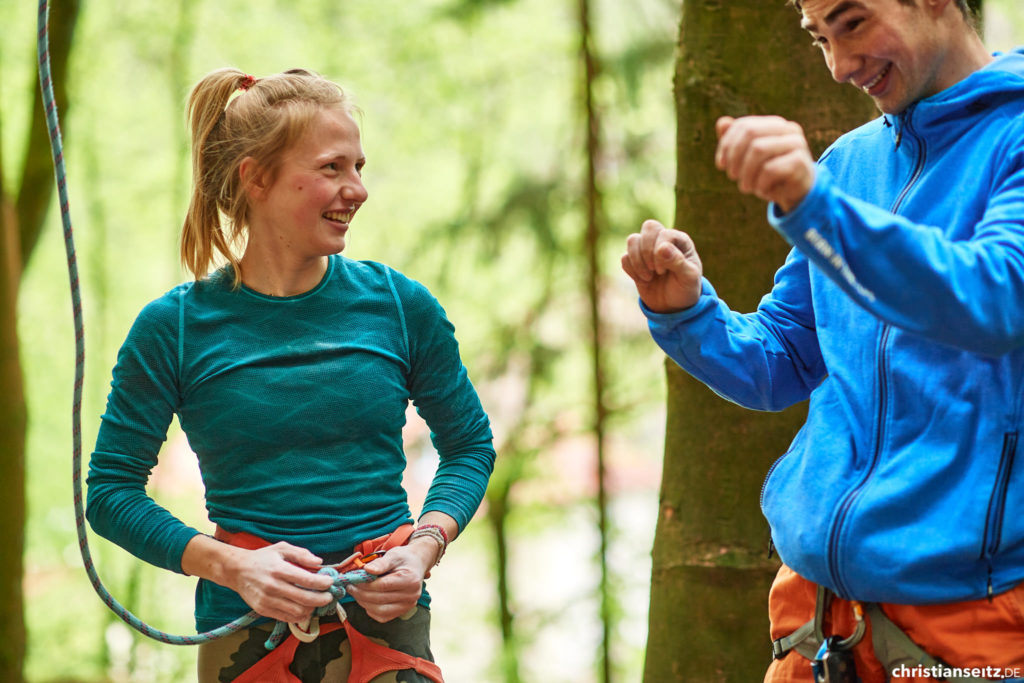
4. Can you say what your key to success was? If you had to give a tip, what would you say?
I don't know what the key to success was. I don't think there is one and think it just comes over time, even if it wasn't that long for me. I always like to say: "approach the thing without expectations", although that doesn't come so easily to me. But it is simply important that you approach it with fun, enjoy it and don't put so much pressure on yourself that it should work now, because then it usually doesn't work anyway.
My tip would definitely be: no matter what tour, even if it doesn't look so good sometimes or you think: "that is not my style at all", just try everything and do as many different routes and sequences as possible so that you are well rounded. When you then try a new climbing tour, you can read new sequences faster and don't need as many attempts until the solution and can thus save strength and attempts.
Then I would give another tip: pay more attention to hip mobility and leg work and above all incorporate many technical things at the beginning. Even if it doesn't work sometimes, you should not always think: "I have too little strength". That may be true, but especially at the beginning it is usually not the main reason, because you can learn a lot of technique that achieves a lot. I can still learn a lot today, because with every tour new sequences come and you constantly learn from it. That is also what makes climbing so exciting in my opinion.

