

Since 2013 you have been a member of the Austrian youth national team, and your victory at the 2017 Youth World Championships in the junior women's category is one of your proudest achievements. Now the youth competition season is pretty much over, marking the end of your youth career and your final transition from junior athlete to senior athlete.
Looking back on all those years as a young competitive climber, what challenges did you face and how did you approach them?
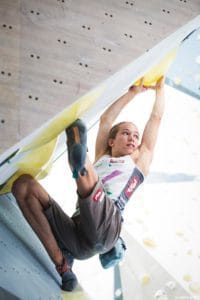
One of the biggest challenges is definitely the sheer number of competitions. Especially in my final years as a junior athlete, I competed in quite a few of them. On the one hand, I was allowed to compete in adult competitions, and on the other, my coaches recommended that I compete in as many youth competitions as possible. The main difference between a youth and an adult season is that the youth season is not as structured as the adult season. Adults start with a few bouldering competitions, followed by a few lead World Cups, which allows them to start the season with maximum strength training and continue with endurance training, with some speed training in between. It is different in youth, as international bouldering, lead, and speed competitions alternate. This means that if you are aiming for the "Combined Format," you are expected to train for all three disciplines throughout the year. And when you are old enough to compete in junior and adult competitions, the whole thing becomes even more intense.
Most Austrian competitive athletes attend a school that specializes in sports and making it as easy as possible to combine school with professional sports. That was not the case for me, which made it even harder for me to find the balance between education and sports. If I hadn't been a fairly good student who could learn quite easily, none of this would have been possible for me. I usually didn't come home after school; instead, I went straight to training, ate lunch on the bus, and did a bit of homework on the side. After training, I would finish the rest of my homework and studying, and then go to bed. As you can imagine, this is not only physically but also mentally exhausting.
Speaking of mental strength, I also had regular mental training with a professional sports psychologist, who not only helped me combine school and training and overcome stressful periods, but also deal with pre-competition nerves, which had a major impact on my climbing in the past. I didn't have pressure from anyone else, like my parents or coaches, but I put a lot of pressure on myself and my climbing performance. I was very success-oriented, which is why I was often very nervous at competitions. With mental training, pursuing my own interests, and working on mental strategies, this became much better and now allows me to climb much more relaxed.
The good thing is that I had almost no physical problems during my youth career. I was never seriously injured or ill, which allowed me to train without having to take any forced long breaks. The only minor problems I can think of were growth-related. There was a year in which I grew almost 10 cm, and I remember having slight pain in my back and fingers. It was also hard for me to judge my size when I read the routes and boulders, and sometimes I was surprised by how easy the seemingly large moves turned out to be.
Oh, and I almost forgot to mention my first pump, which I got when I hit puberty—the struggle was real!
 How did you perhaps benefit from these experiences compared to young people who are not professionally involved in sports? On the other hand, do you think you might have missed out on something because of your tight schedule?
I think that by being a professional athlete, I have already learned a lot. I know how to plan my daily routine and have the discipline to stick to it. As an athlete, you also have to be confident, which can also be a major advantage in other life situations. Not to mention all the different cultures you get to experience at competitions in other countries—the countless hours and the stress are definitely worth it!
Personally, I don't think I really missed out on anything in my youth. I never really did much with my classmates, as they didn't really understand what it meant to be a professional athlete. In any case, almost all my closest friends were also climbers and members of the Austrian youth national team. I could always hardly wait for the next training camp or competition and the good times I would have there with my friends!
Still, I can imagine that some young athletes feel like they are missing out on things like going out or meeting friends. In my opinion, they should keep in mind that sports/climbing is not everything, and if they really want to, they can always find a little time to do activities outside of climbing.
Who supported you the most, and did you have a role model who helped you meet all your obligations?
My biggest support came (and still comes) from my parents, who often belayed me or drove me to other climbing gyms. My mother is still a kind of "manager" for me.
But my coaches and training partners also supported me and motivated me enormously, and they had a major influence on who I am today.
I had many role models when I was younger, but my biggest one was probably Anna Stöhr. I admired (and still admire) her climbing style and her likability, while she is one of the most successful climbers. Regarding my education, the funny thing is that I am currently studying the same subjects she studied :-D