

Interview with Friederike Petri
Freddy, you've competed in World Cups yourself and have also spent a lot of time outdoors.
In principle, you're on your own in front of the audience, and outdoors, no one can help you through a difficult section either. So, can it be said that you're a lone wolf in the sport of bouldering?
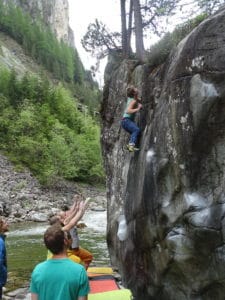
I don't think bouldering can be seen simply in black and white. If I had to put bouldering in a "team sport" box or another "individual sport" box, I would dismantle the cabinet and turn it into one big shared drawer. Sure, in the end you have to climb the boulder on your own and win the World Cup yourself. But such success doesn't depend on you alone. It also involves your environment, your fellow competitors, your teammates, the audience, your coaches, and your bouldering friends. They significantly influence your development and success. This can happen in different ways. Whether it's training together, where you motivate each other, give tips, and support one another. Whether it's at the crag: your friends who spot you, cheer you on, and give you beta. Or whether it's the audience that carries you up the wall in the final with their encouraging cheers. For example, when I'm bouldering alone, I can't perform as well as when I'm out with friends or teammates who push me. Besides, everyone knows: everything is easier together :)
Training requires a lot of discipline. Whether in terms of consistency, intensity, or the design of a training session. Who and what gives you the motivation to stick with it? Does the team aspect come into play here too?
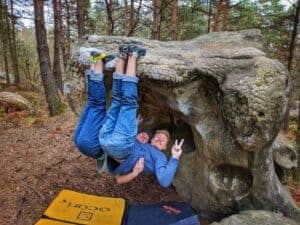
For me, the strongest motivator for discipline is progress. When I notice that I'm getting better, making headway, and having successes, I'm automatically more motivated and disciplined, so I can often push through a few tough training sessions on my own. But what if success stays away for a while? What if you hit a performance slump? Then you can call yourself lucky if you have great, understanding training partners who encourage you and pull you along. That's why I always try to be a driving force myself, who motivates others and encourages them to train.
In team sports like football or basketball, there's almost always a replacement for every player, but the whole team still suffers from an absence. This means that on the long road of rehabilitation, you certainly receive a lot of support from your teammates. You've also had knee surgery behind you.. What experiences have you had in the sport of bouldering?

Even though knee surgery is no end of the world, it is a major challenge for athletic people like me, who devote 90% of their lives to bouldering, to deal with it. It's a long and hard road that can be made considerably easier with teammates/training partners. Sharedsorrow is half sorrow. No, it's nice to know that you can always turn to the help and understanding of your partners. For me, especially in the first few weeks, the exchange with my coach Christoph was very helpful, der had already been through it all and was bouldering again as if he were 20. As soon as I could start doing something again, a lot of consideration was taken for me in training. Boulders were defined without hooking and high tension on the left leg, I was always spotted like a raw egg and repeatedly motivated to keep training and have patience. I am very grateful for that and I really appreciate it. Thank you!
Thank you very much for the insightful look into your rehab time and into your source, from which you draw motivation and ambition for dealing with physical and mental challenges in the sport of climbing. We wish you all the best for your career and are grateful to have you as an asset to the team.
